
This isn't just any rabbit stew—this is Hasenpfeffer, a German masterpiece that transforms humble rabbit into something absolutely sublime. Yes, it takes 2 days to marinate, but what emerges is restaurant-quality elegance: incredibly tender, low-fat rabbit swimming in a complex wine sauce that tastes like it came from a Black Forest kitchen. Worth every minute of waiting.

What is Hasenpfeffer?
Hasenpfeffer is a classic German preparation that elevates rabbit through time, technique, and restraint. Far from a simple braise, it relies on an extended marinade, traditionally wine-based and infused with aromatics such as onions, garlic, and spices. Over several days, the marinade penetrates the meat, gently breaking down its fibers and laying the foundation for a dish that becomes exceptionally tender and deeply flavored once cooked.
Rabbit is particularly well-suited to this method. It is lean, high in protein, and more digestible than many heavier meats, which allows it to absorb flavor without becoming greasy or overwhelming. Modern culture often treats rabbit as sentimental or ornamental, but it has long been a respected and practical protein in European kitchens, valued for both its availability and its versatility.
Sourcing rabbit today is straightforward. Most good butchers carry it fresh or frozen, and either works well for this dish. What matters most is not the provenance, but the care taken in preparation: proper marination, controlled heat, and patience during cooking. When treated correctly, the meat becomes supple and cohesive, with a depth of flavor that lingers rather than overwhelms.
Hasenpfeffer is a dish people tend to revisit, not because it is flashy, but because it rewards attention and time with consistency and elegance on the plate.
Jump to:
If you can't or don't want to use rabbit, you can absolutely make this with chicken instead. Just be sure to remove the skin from the chicken first, so you don't have to deal with flabby skin floating around in your beautiful braised dish.
I hate flabby skin.
Nobody wants that rubbery, unappetizing texture in an otherwise elegant meal. Trust me on this one—skinless chicken thighs work wonderfully and won't leave you picking soggy skin out of your stew.
More information about making Hasenpfeffer (German-Style Wine Braised Rabbit) is below the recipe card
Hasenpfeffer (German-Style Wine Braised Rabbit) - Recipe Card
Ingredients
- 1 whole domestic rabbit cut into portions (have your butcher do this if you want)
For the Marinade
- 2 ½ cups chopped onion about 2 medium
- 12 cloves garlic sliced
- 2 bay leaves torn if fresh or crumbled if dried
- 10 - 12 whole peppercorns
- 6 - 8 whole cloves
- 1 750 ml bottle dry white wine a Fume Blanc works well here
For Cooking
- Salt and freshly ground pepper
- 2 tablespoons extra virgin olive oil
- 1 tablespoon butter
- 2 - 3 tablespoons flour
- 1 - 1 ½ cups chicken stock
Instructions
- Day 1-2: Marinate the RabbitPrepare the Marinade:In a deep, non-reactive bowl, combine chopped onion, sliced garlic, bay leaves, peppercorns, cloves, and white wine. Add rabbit pieces, ensuring they are completely submerged in the marinade. Cover tightly with plastic wrap, placing a plate on top to keep rabbit submerged. Refrigerate for at least 24 hours, preferably 48 hours for deeper flavor.
Day 3: Cook the Hasenpfeffer
- Preheat oven to 325°F (165°C)Remove rabbit from refrigerator 30 minutes before cooking. Remove rabbit pieces from marinade, scraping off any clinging onion or garlic. Pat rabbit completely dry with paper towels (crucial for proper browning).Strain marinade through a fine-mesh sieve, separating liquid from solids. Reserve both the strained wine and the aromatic solids separately2. Brown the RabbitIn a large, heavy Dutch oven, heat olive oil and butter over medium-high heat until butter is melted and frothy Season rabbit pieces generously with salt and freshly ground pepperWorking in batches to avoid overcrowding, brown rabbit pieces on all sides until deeply golden (about 8-10 minutes total per batch)-Don't rush this step - proper browning develops crucial flavor.Transfer browned rabbit to a plate and set aside
3. Build the Base
- Reduce heat to medium. Add reserved marinade solids (onions, garlic, herbs, spices) to the same pot.Cook, stirring frequently, until onions are soft and translucent (about 5-7 minutes).Sprinkle flour over the vegetables and cook, stirring constantly, for 2-3 minutes to eliminate raw flour taste Deglaze and BraiseGradually stir in 1 cup of the reserved marinade wine, scraping up any browned bits from the bottom. Cook until mixture begins to thicken (about 3-4 minutes). Return rabbit pieces and any accumulated juices to the pot. Add chicken stock gradually until rabbit is just covered (about 1 cup).Add more marinade and stock in equal portions if needed.Bring to a gentle simmer. Oven BraiseCover pot with tight-fitting lid. Transfer to preheated oven. Braise undisturbed for 1½ hour
4. Finish the Sauce and Serve
- Remove pot from ovenCarefully transfer rabbit pieces to a serving platter and keep warm.Strain the cooking liquid through a fine-mesh sieve, discarding solids.Return strained liquid to pot and bring to a simmer on stovetop. If sauce needs thickening: Mix 2 teaspoons cornstarch with 1 tablespoon cold chicken stock to create a slurry. Whisk into simmering sauce and cook until thickened (2-3 minutes).Taste and adjust seasoning with salt and pepper. Arrange rabbit on serving platter. Spoon warm sauce generously over rabbit. Serve immediately
Notes
Nutrition
Traditional German Hasenpfeffer (Rabbit Stew)
A Family Recipe Passed Down Through Generations
A Family Recipe Passed Down Through Generations
Rabbit or Hare?
While "Hasenpfeffer" literally translates to "hare pepper," this recipe uses domestic rabbit instead of wild hare. There's an important distinction: rabbits and hares are quite different animals. Rabbits are born bald and blind, while hares are born with fur and full sight. More importantly for cooking, hares have a much stronger, gamier flavor compared to rabbit's mild, white meat.
I think rabbit is to hare in flavor what lamb is to mutton—and while I love lamb, I don't like mutton.
Rabbit meat is surprisingly mild and versatile. You could substitute rabbit in any dish that calls for chicken, though they don't taste the same. And honestly, why does everything that's not beef or pork always have to "taste like chicken"? Maybe it just tastes like rabbit!
Family Tradition
There are probably as many family recipes for Hasenpfeffer as there are for Paella—each family does it a little differently. This recipe comes from my great-grandfather, who was a chef in Germany. It's not entirely "traditional" in that my Hasenpfeffer uses no vinegar in the marinade, only white wine.
Why? Because I like it that way. My Oma made it that way, my mother made it that way, and I make it that way.
Rabbit - Farmed or Wild?
When I lived in Germany with my grandmother (Oma) for a while one year, she made Hasenpfeffer for me. Her rabbit was wild, so it had dark meat—not white like my farmed domestic rabbit. As a result, instead of white wine, she used red wine, but everything else was done the same as my family (Aunt Christine aside) has done for years.
I suggest: if you're going to hunt your rabbit yourself, you should probably use red wine instead of white as well.
The darker, gamier meat of wild rabbit pairs beautifully with red wine, while the milder domestic rabbit works perfectly with white wine.
So full disclosure, there are no vegetables in this "stew" just some great tender rabbit with a tasty, tasty gravy
FAQ's
Step-by-step (head off, cleaned)
1) Remove the forelegs (2 pieces)
Pull one foreleg away from the body.
Slice along the natural seam where the leg meets the chest.
There is no shoulder joint, just muscle.
Repeat on the other side.
2) Remove the hind legs (2 pieces)
Bend a hind leg outward.
Cut through the skin and muscle at the hip.
Pull gently to expose the ball joint, then cut cleanly through it.
Repeat.
3) Locate the correct saddle cut
Feel for the last rib with your fingers.
The saddle begins immediately behind that rib.
Make a straight crosswise cut just behind the last rib.
Use shears to cleanly cut through the backbone if needed.
Front rib/chest section goes to stock or the braise.
4) Cut the saddle into 3 pieces
Place the saddle bone-side up.
Left loin
Run your knife tight along one side of the spine.
Lift the loin as you free it, keeping it intact and boneless.
Right loin
Repeat on the opposite side.
Center saddle
What remains is the bone-in center section.
Trim edges; cut in half crosswise if large.
Final breakdown
2 forelegs
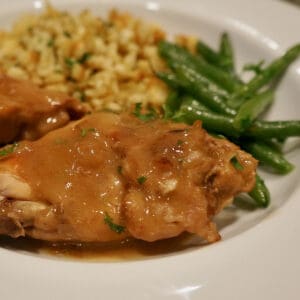
I served this with Mustard-Thyme Spaetzle and Steamed Fresh Green Beans.

Chef's Notes
Traditional Accompaniments: Serve with spaetzle, egg noodles, or boiled potatoes, and red cabbage or sauerkraut.
Make-Ahead: This dish actually improves in flavor when made a day ahead. Cool completely, refrigerate, then gently reheat before serving.
Rabbit Substitutions: If rabbit isn't available, this recipe works excellently with chicken thighs or even venison.
Storage: Refrigerate leftovers up to 3 days. The flavors continue to develop and meld.
Wine Pairings for Hasenpfeffer
White Wines (for Domestic Rabbit)
- Fumé Blanc - The recipe's recommended choice, crisp and herbaceous
- Sauvignon Blanc - Bright acidity cuts through the rich sauce
- Dry Riesling - German wine for a German dish, with good minerality
- Pinot Grigio/Pinot Gris - Clean, light body that won't overpower the mild rabbit
- Albariño - Spanish white with good structure and citrus notes
- Sancerre - French Sauvignon Blanc with elegant mineral finish
Red Wines (for Wild Rabbit or Heartier Appetites)
- Pinot Noir - Light enough for rabbit but with earthy complexity
- Côtes du Rhône - Medium-bodied French red with herbal notes
- German Spätburgunder - German Pinot Noir, perfect cultural match
- Beaujolais-Villages - Light, fruity red that won't overwhelm
- Barbera d'Asti - Italian red with good acidity and moderate tannins
German Wines (for Authenticity)
- Grüner Veltliner - Austrian, but close enough! Peppery and food-friendly
- German Gewürztraminer - Aromatic and slightly off-dry
- Rheingau Riesling - Classic German choice, dry or off-dry
- Baden Pinot Noir - If you want to go red and stay German
Pro Tip: Whatever wine you choose for pairing, consider using the same wine in the marinade for perfect harmony!
Lola says
I made this for Easter and it was divine! I really appreciate your explanation of using white wine instead of red. There were a lot of recipes I found that used red wine and I'm glad I used this one. The only changes I made was to also use juniper berries in the marinade as I saw that was used in other recipes and I had them on hand though I doubt it did much to alter the marinade. I also shredded the rabbit and added it back to the stew as I have a relative that won't eat off of the bone. Thank you for sharing this recipe!
Linda Baker says
Lola, I'm glad you enjoyed the recipe. And yes, Junioer berries are generally in Hassen but I don't like the flavor so I always omit them as my mother did. Eating off the bone is one of the best things...but I understand some peoples reluctance to do so. Cheers in Good Cookin ~ Lindy
Chuck says
I made this from my own raised rabbits and I am anxious to try it on wild harvested rabbits. Any recommended variation when cooking this with game? I also found the inexpensive Sauvignon in the grocery store worked well for the marinade. Thanks!
Linda Baker says
For wild harvested rabbit:
With the difference between a domestic and wild rabbityou need to consider the following.- Aging: Wild rabbit benefits from aging for 1-3 days in a refrigerator to tenderize the meat and develop flavor.
Marinading time: Wild rabbit requires a longer marinade (24-48 hours) in the vinegar-wine mixture to help tenderize the tougher meat.
Cooking time: Wild rabbit needs to be cooked longer and at lower temperatures (slow and low) - often 30-45 minutes more than domestic rabbit.
Fat content: Wild rabbits have significantly less fat, so you'll need to add fat (like bacon or additional butter) to prevent dryness.
Flavor intensity: Wild rabbits have a stronger, gamier flavor that might require more robust seasonings. Cheers and let me know how it turns out! ~ Lindy
Debbie says
I only have rabbit breasts, would this recipe still work? And would I cook it less time.
Linda Baker says
Do you mean the saddle? The loin area or the upper chest meat,is lean and tender. Most often, rabbit is butchered into saddles (back and loins), legs, and shoulders, with the loin being the closest equivalent to a "breast" in terms of tenderness and usage. If using the loin part, I generally roll it into.a cylinder, and tie it with cooking string. Then cook it after marinating. Cheers ~ Linda
Jocelyn says
This sounds fabulous!! I was wondering what red wine did your Oma use?. I'm going to make one with white wine and the other with red, but didn't know what red would be best to use.
Linda Baker says
Hi Jocelyn, I really didn't pay that much attention to the brand or type but being in Germany I would assume a German red wine such as Spätburgunder, the German name for Pinot Noir. Its earthy and fruity profile complements the gamey flavor of rabbit and the dish's rich spices. If not Spätburgunder, you could also use a Dornfelder, a slightly fuller-bodied German red with dark fruit notes. Or perhaps she used Vin de Pays a rustic French wine perfect for cooking and sipping. But any red wine would work. Including a Burgundy in a JUG...Cheers to Hasenpfeffer! Lindy
Theresa Holmes says
I was wondering if a Chardonnay could be used in lieu of the fume blanc?
Linda Baker says
Yes, just make sure that it's not an overly oaked (too yellow in color). Keep it to the more ""naked" side. Cheers ~ Lindy
David says
Peppercorns & cloves are listed in ingredients but there is no mention of their use in instructions.
Linda Baker says
Hi David, if you look, you will find them as a part of the "marinade" ingredients. They can be left while cooking as well, but do need to be removed prior to serving. Cheers ~ Lindy
Doris Denise Lyke says
I tried it years ago when my grampa was alive, and went rabbit hunting. I didnt know it was a real recipe. I'd seen it on a Bugs Bunny cartoon!! So I looked it up, and, sure enough, it was a real recipe. Very tasty, took 2 days, but wow!!
Linda Baker says
Yep, not a quick recipe but since most of the time is hands free it is still and easy and delicious recipe. Thank you for stopping and sharing your thoughts and memories. (and I loved the Bugs Bunny cartoon as well) Cheers ~ Lindy
John says
OMG... Amazing... I guess now after learning that my last name means rabbit hunter ...Hasenjager... I'll be making a lot more of these dishes.... I've found my new meet. Just delicious.
Linda Baker says
Hey John, or should I call you Mr. Rabbit Hunter? Then this dish is just right for you. Thanks for the comment and enjoy the tasty rabbit. Cheers ~ Lindy
Queeni says
I made it. Delicious and two diners left enough meal for a stew to feed three others.
Recipe easy to follow. A hit here.
geoff purcell says
any tips for doubling or tripling the recipe? we are going to make this for 7 adults.
Barbara Dietrich- Brandt says
This is my favorite meal, years ago in the 1970,s there was a restaurant in La Jolla, CA that Oma and Opa used to take the family to and I always ordered Hasenpfeffer. It is so delicious. The restaurant closed and this tradition ended! I look forward to trying your recipe.
LindySez says
I hope it brings back fond memories. Cheers ~ Lindy
LindySez says
Thanks for stopping by Sam...I'm glad you enjoy the recipe and get those skeptics to clean their plate. I'm sure your Lapin Au Vin turned out terrific and I loved your story about not putting eggs in your pockets...been there done that! Cheers ~ Lindy
Elle says
You have such inventive recipes Linda...you should be on The Taste on TV.
LindySez says
Thank you Elle. That's the one that is just one great bite right? I could do that!
Cher says
Wow! Sounds delicious! I'd really like to try it...
LindySez says
You should so try it…easy and good. Fall off the bone tender...
jack waytz says
Nowhere in the recipe does it say the correct oven temp. That would be most helpful! I plan to cook this today, so I'm hoping for a quick turnaround time on your response. Thanks, -Jack
LindySez says
Did I miss the temperature? In the oven, it would be set about 325ºF. Sorry about that. I'll double check and make a correction. Cheers ~ Lindy (Hope I'm in time!)
LindySez says
Jack, it was a coding error...one has to remember to close their brackets 🙂
LindySez says
Absolutely, make more :-). No seriously, 2 rabbits should feed 7 adults with side dishes, so just double the amounts. Brown the rabbit in batches and then place it in a large pot to complete the recipe. The rabbit pieces do not have to all be on the bottom of the pot, but they all should be covered with the wine when cooking it.You could also brown the rabbit and then use a slow-cooker to cook. 6-8 hours on low should do it. Then finish the gravy on the stovetop. Let me know if it works out. Cheers ~ Lindy
Jessica says
This sounds like a winner! I've never tried Rabbit before, but I am intrigued now!